Thursday, November 10, 2011

Vintage Baritone Ukulele

I Just Got One...

I just bought a vintage mahogany Harmony baritone ukulele on eBay for less than $100, including shipping. It looks to be the same model as the one in this picture but I can’t say for sure. I’m taking a chance of course, since I don't know what it sounds like. But the price was too good to pass up. I think one reason I got it so cheap is that the owner spelled it "ukelele" in the eBay listing and a lot of people who were searching for this kind of thing and spelled it correctly never saw it. I can't wait to get it and see what I can do with it.

What got me started was I was hanging out with some friends at the Occupy Chase protest in Ashland and a passing friend taught me how to play Jump You Fuckers on a concert uke and then we videoed it and put it up on youtube and it's got like 1600 views in a few weeks. It was fun, I liked the way it sounded and it was a nice introduction to the instrument. I'm not really much of a musician so I'm not planning on working any wonders on the uke beyond some nice grooves or moments. And I'm not interested in the ukulele "craze" really. I just liked the sound and portability of my first encounter with one and wanted to explore further.

I started putting the word out that I was interested in finding a decent ukulele and within a day or so two of my friends offered to lend me their vintage mahogany ukes, but I declined. I don’t like to borrow instruments I have no chance of buying. I don’t want to get attached to something I have to give back. But one friend did have a vintage Martin mahogany uke that she was willing to sell me, but it was a soprano which is very small, tiny really. I’m borrowing it right now, but I’ll probably pass on it.

I am still going to get a decent concert size uke (one step bigger than a soprano) and maybe a tenor as well. The baritone I just bought is the largest size, from what I understand. I think the usual tuning is just like the highest four strings on a guitar, but they can also be tuned like a tenor uke or like a tenor guitar, which is what I’m leaning toward. I’ll have to see what it sounds like first.

I’m looking forward to getting to know my way around the basic chords of whatever size uke I happen to be playing and then letting my ear lead me to the kind of sounds I feel like making. I have no clear idea what direction I want to go with this instrument, I’m just drawn to it and I’m going with it.

Sunday, November 6, 2011

Hard And Soft

Finding The Balance

As I see it, the key to having real and deep firmness in your being is to have real and deep softness as well; and the key to having real and deep softness in your being is to have real and deep firmness. One without the other isn't very real and isn't very deep.

Firmness and softness are inter-related in that one without the other tends to be superficial and not very substantial. For example bullies tend to be superficially tough, but not nearly as tough as people who also can be soft. And hippies tend to be superficially soft, but not nearly as soft as people who can also be firm.

It's another way of talking about Yin and Yang, which according to traditional Chinese thought, don't really exist in any healthy way without each other. The Tao Te Tching says: Know the Yang but keep to the Yin. That first part is what so many hippies and New Agers would rather avoid...

Another example: “Beating swords into plowshares” is powerful, because you know the sword but decide not to use it. Never knowing swords in the first place and then beating them into plowshares is weaker, because you are being "peaceful" but you have no choice.

This interrelatedness of opposites can be applied to many of the seeming contradictions in human nature.

I think trying to deny, banish, or "transcend" one half of the many splits in ourselves is a recipe for trouble. Firm/Soft, Civilized/Animal, Violent/Peaceful, Competitive/Cooperative, Loving/Lustful, Greedy/Generous, Self-Interested/Altruistic, One/Separate...these are all hard-wired and valuable aspects of human nature. For me, balance is the key to life, not purification. And the key to balance is to first accept these dual aspects of our nature.

But that won’t do away with being out of balance. I don't think we can banish being out of balance from our lives. Balance can't be clung to or it ceases to be. You have to accept imbalance in order to have balance, which is actually a verb not a noun. It is always in motion, always a vibration between lost and found and lost and found and lost and found.

And so, sometimes I have the key and sometimes I am keyless. Sometimes I feel balanced and sometimes I don’t. I do my best to accept that and try not to cling to either state. Sometimes a little purification is not a bad thing. The need to attempt purification is human too.

But what seems so wasteful, selfish, and pointless to me is people's life long strivings to overcome, eliminate, deny, or "transcend" things that are built into our natures as human beings. This seems futile to me and the cause of so much violence and suffering in the world, turning people against their own bodies and selves, fueling murderous insecurity, and countless "holy" wars.

As I see it, true balance means true acceptance of who we are and living in the dynamic tension between our opposite qualities. I see this as an endless work in progress. I may never reach any kind of permanent state of balance but orienting in that direction seems like the best route to peace, joy, kindness, and the life I'm interested in living. Hard and soft, not hard or soft.

Wednesday, November 2, 2011

My Editing Process

"Peace Of Mind" Becomes "My Unforced Life"

My Friend and T’ai-Chi student John Soares has a great blog called “ProductiveWriters.com” where he recently posted an article called “Should You Edit As You Write?” In the piece he discussed the pros and cons of editing as you go, versus editing later and many other writers commented sharing how they handle this issue.

My comment was:

“For me it depends on what kind of writing I’m doing. If I’m feeling inspired and on a roll, I don’t even bother with paragraph breaks, misspellings or even quotation marks. I just shoot from the hip until the wave has passed. If I’m working something out and developing an idea or line of thought, I’ll be more thoughtful and edit some as I go. But generally, I write first from a creative, free-spirited, uncensored place and then go over it afterwards to clean it up.

This is true of everything I write, whether it be songs, blog posts, emails or website comments. I often go through several drafts before I consider it “done”.

For instance, I might want to turn several facebook posts on a given subject into a blog post. I will have saved these posts in a folder in my computer. One night I’ll open them all up and put them in a rough working order in a Word document. Later I’ll go over it and clean up redundancies, people’s names I might have mentioned and language more suited to facebook than my blog. I might still go over the entire piece once or twice more, looking to see how it works and flows as a whole before I decide it’s ready to post.

Other times, I’ll get an idea, do a quick rough draft, go over it once or twice to smooth it out and then go ahead and post it. So the process can take weeks or it can take minutes. But then I’m not a professional. I can see that if I was, I’d have to decide not only which style pleased me most, but which style got the job done best with the amount of energy I could give it.”


Recently, I submitted an article to our local paper for a column about all aspects of “Inner Peace”. I also posted it here with the title “Peace Of Mind”. I got an email back from the editor of this column saying my submission was 750 words long and if I could edit it down to 700 words or less she would publish it.

So I set about “editing” it but I ended up doing a pretty substantial re-write that took about 4 hours! I guess it was just one of those cases where I wanted to get it as close to exactly right as I could get it. I just kept going over it and over it until nothing bugged me. That 700 word limit was exasperating at times but ultimately I think the re-write is better. Here it is with a new title:

My Unforced Life

Peace of mind does not exist in my world. In my experience, minds are not peaceful. I have experienced that it's possible to become more peaceful of mind, I am relatively sure of that. But I've never experienced, nor have I felt that anyone else was experiencing pure peace of mind.

Only two things have actually brought some measure of peace to my life. One has been accepting that parts of me are not peaceful, never have been, and probably never will be. The other has been doing what feels most deeply right to me.

By admitting to myself that in addition to their opposites, I am also competitive, aggressive, lustful, angry, scared, selfish, greedy, violent, and warlike, I invite these parts of myself to be full-fledged members of my internal family or parliament. They don't have to become outlaws and demons to be fought with. When I accept and allow them to have some expression, these so-called “darker” parts of myself begin to relax. I don't fight them, I just temper them. They don't fight me, they just make themselves known. Rather than fighting to be “good”, I focus on unforced balance and accepting myself as I am. And less fighting in my mind means more peace in my mind.

I find this to be true again and again. I have more peace in my mind when I accept the war in my mind. Certainly more than I do when I try to be peaceful. Trying to be peaceful seems like a contradiction in terms to me, like being determined to relax, or trying to lift a chair I’m sitting in.

I call myself a “freestyle” Taoist because rather than the 1200+ volumes that comprise the orthodox Taoist canon, I focus instead on 4 words: Flow more—Force less. This is the heart of my life, both as T'ai-Chi teacher and singer/songwriter. I've spent over 25 years studying how to "flow more—force less" in countless training exercises within the T'ai-Chi system. I've spent even longer working on reducing excess effort as a singer, writer, and performer. And yet I still force things all the time.

What’s important to me in life is not so much what I hit as what I aim for. My target is what I call "the unforced life”, the life that I don't have to force myself to live, where each action is done with just the right amount of energy needed to achieve its ends. I've studied this on a daily basis for decades and still, what progress I've made has been slow, with many small steps.

Living in the dynamic tension between my various opposites has not been easy, but I vastly prefer it to trying to banish or eliminate parts of myself that seem hard-wired into me by Nature. When I accept myself as I am, my shoulders relax and sink, martial techniques become more effective, my hands find the right sound on my guitar, my voice opens a bit, I find the words I’m looking for, I connect better with my friends, I breathe easier, and once again, a small measure of peace emerges.

My unforced life comes gradually, by accepting whatever is happening inside of me. Not liking it necessarily, but accepting it, accepting that it's happening. Things are always changing and conflict seems inevitable, but when I accept what's going on in me, I’m less conflicted.

With less preoccupying conflict in my life, it’s easier to identify what feels most deeply right to me and easier to act on it. I've learned to trust this "most deeply right" feeling completely. I trust that it will lead me, directly or indirectly, to the right life, the unforced life that includes both the “light” and “dark” aspects of my nature. As I get better at identifying and acting on this inner "right" feeling, my lessons are not as painful, I flow more and force less, I have more satisfying and enjoyable experiences of myself and the world around me, and yes, even a bit more peace of mind.

Gene Burnett is a T’ai-Chi teacher and singer/songwriter living and working in Ashland. www.GeneBurnett.com

Tuesday, November 1, 2011

Doubt

I Put Nothing Beyond It

I don't want to resolve doubt. I like doubt. It keeps my mind open. I even like doubting things I don't actually doubt. What I don't want is paralyzing doubt. Doubt is like a spice to me. You don't want to make a meal of it, but a meal without it is kind of dull...

But unreasonable doubt is, well, unreasonable. When it comes to whether or not I am writing in English right now, I would say that I have no doubt that English is being written. None at all really, which, while it makes me suspicious, doesn't change my mind.

What I would doubt a little, and really just a little, is that the "I" in "I am writing in English." is who's really doing the writing. Or whether that "I" is real or not. Or whether "you" the reader are real or not. Or whether the physical reality in which I write and you read is real. About all of these things I have some doubt. Not enough to change my behavior significantly, but enough to keep me alert to the possibility that things might not be what they seem.

Since there's an "I" in anything I perceive, I have to include some doubt about that "I" in almost everything. Just some though. I exaggerate that doubt a bit to make a point.

I feel like the essential "me" is naked and at best a bit uncomfortable with that, so part of me is always putting on the "clothes" of certainty to make me feel better, but another part of me would rather just get used to being naked and is constantly undressing. One part keeps solving the mystery and the other part keeps reviving it. In between is where the action is for me, living in the tension stripping and dressing.

If pressed to be absolutely as accurate as possible I would say I'm not certain of anything, not even that last statement. But in everyday life, I accept the necessary compromise and say, Yes, I'm sure, when what I really mean is that I'm virtually sure. And virtually means almost but not.

I have to say things that aren't strictly true, but are virtually true. Keeping this in mind keeps me from being too certain. It keeps doubt alive. And I like doubt. Doubt to me is a wonderful thing that keeps life from getting stale and keeps me from mistaking words for the things they describe.

I think there’s always something "wrong" with any statement. Not in the logical sense, but in the sense that there is always room for doubt or an alternative point of view. Every truth starts with some assumptions. Examine those and you will find room for "error" or inaccuracy. As I say in my song “You Are Wrong”, even "1 + 1 = 2" assumes that there is such thing as "one" or "two" of anything, that separate things exist, that boundaries exist, that adding things together exists, and that two things can be "equal". You may very well make all these assumptions, I do all the time in everyday life, but you don't have to. You could also assume that "1 + 1 =2" is an error ridden convenience that makes lots of things work better.

Sunday, October 30, 2011

Lyrics or Music

Which Comes First?

Sometimes people ask me about my writing process and one question I get quite a bit is “which comes first, the lyrics or the music”. My answer has changed over the years.

Here’s the long answer:

I used to write music and lyrics together, more or less line by line, but for the past several years, it's almost always been lyrics first, or at least most of the lyrics first. Partly this is because I write at night and my wife is a light sleeper and partly just how my process has evolved.

I usually have some rhythm or basic tune in my head while I'm writing the lyrics, but that can change when I pull out the guitar, which I do when I'm either done with the lyrics or at an impasse where I feel the momentum of playing the guitar might suggest a way through.

The process usually goes something like this:

I carry small squares of scratch paper with me at all times. I’ll get some kind of inspiration, maybe it’s an idea for a song, maybe just a line or two, or an interesting phrase, which I of course write down.

I then go over these pieces of paper later and see if they still feel promising. I then see if I can add anything, another line or a rhyme, anything to help it along. I add further verses or ideas on more pieces of paper and clip them together with similar material. I usually have many of these little bundles going at any particular time.

When I go to write, I just pull out my stack of clipped together works in progress and see if any of them grab me, starting at the top of the stack. If so, I see what I can add, if not, I go to the next one. Once I’ve got what I think is enough for a complete song, I’ll pull out the guitar and see what feels right to go with what I’ve written.

When it’s starting to really take shape, I then write the lyrics to the song in a notebook and from there I type them into my computer. It somehow helps me to remember the lyrics when I first write them by hand in the notebook first. I’m not sure why.

At that point I start to play the song in public, usually at an Open Mike but not always. Sometimes I debut a song at an actual gig, but I prefer Open Mikes. As I play the song out the first several times, it usually changes a bit. The tempo might slow down or pick up or the lyrics might change here and there to better fit the phrasing and timing as the song gets broken in. Before too long the song sort of “gels” into its more or less final version which I then record when I start my next album.

Sometimes I go to write and I’m just not into it. I feel like doing something productive though, so I’ll pull out all my idea bundles and good lines and stuff and sort through them all. I’ll usually divide them into categories like, strong prospects that are at or getting close to the place where working on them with guitar might be in order, ideas that need more work but are still promising, interesting lines and un-fleshed out ideas, stuff I’m not excited about but think maybe I’ll be more into down the line a bit, and stuff I’m just not into at all which I usually throw away. The rest I separate into piles that I can dive into when I’m in that particular mood.

The next time I go to write, I can grab the pile that’s almost done and, if it’s getting late, polish or add to the lyrics, or if it’s not, get out my guitar and see what happens. Or I can grab the pile of half-finished prospects and see if any of them inspire me to move them along a bit further. Or I can look over my barely fleshed out ideas and see if any of them inspires me to dig in and develop them more. Or I can dive into the pile of ideas that left me cold the last time I looked and see if anything has changed.

This is a more organized approach than when I was younger when I mostly worked on songs that emotionally demanded to be written. A lot of my emotionally driven songs are out of my system now and I find I’m more interested in ideas, releasing a charge for myself, word-play and capturing certain states of mind and body. I’m not trying to write good or pleasing songs really. That’s secondary. The main thing for me is to write a satisfying song, a song I feel better for having written.

My current approach serves my goals very well. In the world and in my thoughts, I listen for sounds, ideas, phrases and combinations of words that release a charge for me, that is to say, give me this large or small “yes” feeling. I don’t need to know why or what it’s about. All I need to know is that there’s a release of charge. I trust that if that’s the case the meaning behind that release will come in its own time. I just see if I can add to the initial phrase or idea in a way that also releases a charge or amplifies a previous one. As I build my lyrics, sometimes I have no idea what the song is really about, but as I go, it becomes more and more clear and then voila, I suddenly know. Other times I know what I want to say, I just have to find the right words, rhymes and rhythms to best make it happen. I feel kind of like I’m trolling in the world of my unconscious mind, relying on my sense of what feels most deeply right, collecting and connecting bits and pieces of inspiration and then patching them together into songs that express what I feel and think as my life unfolds.

Here’s the short answer: Usually it’s lyrics first, then music.

Friday, October 28, 2011

Detours...

Embrace The Adventure.

If you’ve studied any art consistently over a period of many years, whether it’s songwriting and T’ai-Chi I have, calligraphy or painting or dance, you know about detours in your practice. Detours are where you can’t go to the place you want to go in your art without taking a more circuitous path than the one you wanted to take.

The most obvious example would be injuries. You’re ready to go in a new direction or even just continue in the one you’re going, but you injure some part of your body that demands you take a detour. Suddenly you have to paint with your left hand, or half as often as you’d like, or with only certain brush strokes, or only at a certain speed.

Another example would be when you want to take a step forward that requires a step back. For instance jumping higher might involve a return to basic postural alignment.

As tough and as frustrating as it can be to take a detour, I’ve found it helpful to remind myself that while detours are not always pleasant, they do get me where I want to go and often much the better for having taken them.

Maybe it’s surrendering my usual control of my direction…surrendering to what’s actually happening and not on what I want to make happen…maybe it’s something about focusing on the moment and task at hand…something about slowing down and paying more attention…something about being on a bit of an adventure rather than on a well laid out track….I’m not sure what it is exactly, but something about detours, I find very valuable and helpful to my overall practice.

Sometimes I don’t even know where the detour is or how to get to it. I just know I can’t go on the way I’m going. Sometimes I have to send feelers down 10 different alleys…10 different song ideas or movement possibilities before the best or most open way becomes apparent. I don’t see any point in sitting at the road block or detour sign complaining…I try to think and act like water when it meets an obstacle…It’s time to find another way. Even if I can’t move or see a thing…I keep looking…and soon enough, the detour appears.

And besides, there’s always infinite room for improvement anyway. How far I get is not as important to me as what I learn and enjoy along the way. Detours are just another opportunity to extract value from life. I may curse them at first, but then I usually just pick up my stuff and continue on my way.

Monday, October 24, 2011

"90 Percent Of Life Is...

Just Showing Up."

I treat all gigs the same, no matter what they look like. You never know who's listening. It might be a weird little podcast with two viewers, both of whom are the host's cousins....and one of them might book people on a major stage or be looking for music for a movie. You just never know.

I focus on the work at hand, which is the one thing I have a little control over. I've seen bands give half-hearted performances because "no one" showed up, and I always think, Gee, I hope you guys have day jobs…

I once played a benefit show at a friend of mine’s kid’s school. I was playing in a room with a bake sale going on, coffee, kids running around, games and face painting in the halls…I had anywhere from no one to 6 or 7 people listening at any one time. This was the kind of gig a lot of musicians wouldn't even take, but I didn’t care. It was a chance to play and I showed up to see what might happen. I played my best, had some fun, made a few bucks in tips and, as I was packing up to leave, the sound guy, whose kids happened to go to that school, came over to tell me that he booked the Main Stage at our premiere venue here in the Rogue Valley and that we should talk about me playing there sometime. (!) I had auditioned for him for two hours without even knowing it. Two years later this connection led to the best and biggest show of my entire musical career.

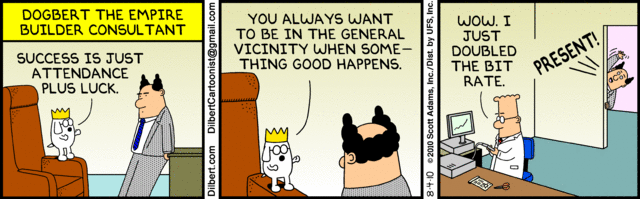
I think Woody Allen said it first, that 90% of life is just showing up and I totally concur. A character in the Dilbert comic strip put it this way: Success is attendance plus luck. Thomas Edison supposedly said: The harder I work, the luckier I get. The way I see it, opportunities to connect with people who will like what I do are shooting around all the time, kind of like bullets. The more I show up, the better my chances of being “hit” by one of these bullets. It may not be the best tactic for someone who’s young, ambitious, impatient with perhaps a limited shelf life, but for someone like me who’s older, not so ambitious, very patient and not even on the shelf, “showing up” has been working great.

And by showing up, I don't mean doing the bare minimum and dragging your ass to things. I mean being out in the world doing what you do in the places where what you do is being done. If you're a musician, that means playing music wherever and whenever you can, in places where people might hear you. If you're an actor, that means auditioning and being in the places where people who might be looking for actors are looking. If you're looking for work that means having a resumé and applying for jobs, maybe even volunteering somewhere until one comes through.

Showing up means making connections, being seen, being around when someone needs what you offer or is offering what you need. I can't tell you how many private lessons I got from my T'ai-Chi teacher over the 13 years I trained with him, simply because the weather was bad or whatever, and I was the only one who showed up for class.


Saturday, October 22, 2011

My Ambition

photo by Ezra Marcos ( http://www.ezramarcos.com/ )

Is To Continue...

I searched the definition of "ambitious" and "ambition" this morning and here are some of the results:

“Possessing, or controlled by, ambition; greatly or inordinately desirous of power, honor, office, superiority, or distinction.

Strongly desirous; -- followed by of or the infinitive; as, ambitious to be or to do something.

Springing from, characterized by, or indicating, ambition; showy; aspiring; as, an ambitious style.”

“An earnest desire for some type of achievement or distinction, as power, honor, fame, or wealth, and the willingness to strive for its attainment.

The object, state, or result desired or sought after.

Desire for work or activity; energy.”

“Having ambition, eagerly desirous of achieving or obtaining success, power, wealth, a specific goal, etc.

Strongly desirous; eager.

Requiring exceptional effort, ability, etc.”

“Having a strong desire for success or achievement; wanting power, money, etc.

Necessitating extraordinary effort or ability.

Having a great desire (for something or to do something).”

At least by these definitions, I don't consider myself very ambitious.

I know I work hard and I'm organized and the things I do are also done by ambitious people, but I don't feel driven towards any particular goal or to achieve any particular level of success of fame. Just doing it is reward enough. I don't feel like I'm reaching for anything either. Just putting my stuff out there and seeing what comes back.

For instance, this year was my best year ever musically, but I have no expectations that next year will be anything like it. I don't find myself at all hopeful. I'm not despairing either, but definitely not hopeful. I don't have the sense that next year will build on this year, or should. I'll just continue to do what I'm doing and see what comes back. If anything, I usually expect that things will get worse and I'm genuinely surprised if they don't.

A lot of people have a hard time accepting this about me. They think that if they were doing what I'm doing, they'd be ambitious, so therefore I must be. But unless it's pretty damn unconscious, I just don't feel it. I'm not indifferent to people liking what I do. I love when people like what I do. But I'm not hungry for it and I don't need for it to happen and it's not my goal to be liked. My goal is to make music and teach T'ai-Chi and see what happens when I do that.

That's my ambition, to continue doing that. In a sense, OK, that means I'm ambitious. But it's not in the everyday sense of how the word is used, or in the way it's defined above. I used to be very ambitious. I wanted to be famous, liked, rich, James Taylor, etc. I was pretty miserable and competitive and pretty bitter when it didn't happen. But since I let all that go sometime in the mid 00’s, I've never had more fun doing music and never been less attached to what comes of it.

I never ask, Will this opportunity further my career? I usually ask, Does this opportunity feel right? or, Will this opportunity be fun? When I opened for America this Summer, people were asking me, "What if America wants you to tour with them?" My answer was, "That is highly unlikely and I almost certainly would not be interested, unless it was for a very short 3 or 5 gig leg. I hate traveling and the life that produces the music I love is this one, not that one."

Anyway, I know this all sounds defensive and who knows? it might be, but it's also in the interest of accuracy and clarity, both with myself and with others that I say it.

If I was more ambitious, always thinking about how each gig, benefit or open mike appearance would affect my career, if I was always strategizing about things like not over-saturating a given market, or getting the maximum bang out of every expenditure of musical energy, or steering my career in a definite pre-planned direction, my life would be very different.

I’m not sure exactly how different or in what ways but I think it would be along these lines:

I might have more and better gigs, or perhaps fewer but better gigs.

I might make more money, get more attention and have more people like me and my music.

I might get to hang out with other more successful people, both socially and artistically.

But…

I might miss all the little casual fun no-ego jam sessions among like minded, in-it-for-the-pleasure of making music, kindred spirits. I’d either not be there in the first place because I was “above” such things, or I’d be there but not really present enough to enjoy myself.

I might miss actually hearing and appreciating the music of my peers which can be really hard to do when I feel in direct competition with them or focused on my own aspirations.

I might miss the kinds of connections with everyday people that a climbing musician might not want to be seen hanging out with.

I might feel more distant from the people who like my music. I might hold them more at arms length for all kinds of reasons.

I might miss being able to tune into my body, feel how it really feels and take care of it. When my attention is acutely tuned to things going on outside of me, things that are changing, “important” and competitively charged, I have a hard time connecting to my own body and attending to its needs. Hanging out at a community musical event with no feeling of self-consciousness about my image, or position or status, I find I can really feel my own body as well as what’s going on around me. I can tune into its needs, its tensions and releases in a way that I just can’t when I’m all excited and strategizing and looking for openings. When I would do that stuff before, I often would have no idea what was really going on in my body until the main events of the evening were over. Only when I got home might I notice an upset stomach or a headache or tight shoulders or a sore muscle area.

I might also miss the pleasure of just liking people without fear of losing anything in the process. When I was strategizing a lot I kept liking certain people in check because it wouldn’t look good in some way or because I was just afraid to let myself. I’m not sure what it was about exactly but there was just this vague fear of liking people too much. It just felt like I would lose something if I did.

In short, while I might be more successful and better at manipulating people and situations to my benefit, and while I might enjoy more of the pleasures of being successful at music, it might be at the cost of the some of the pleasures that come from making music itself. And for me, that trade-off, or the at least the prospect of this trade-off as I see it, are not worth it. And perhaps more importantly, I just don’t have the heart for the ambitious and strategizing life-style. I feel so much better since I let it go.

If you’re young and ambitious and feel like strategizing in this way, I’d say go for it. You might be a talentless, narcissistic buffoon...or you might be a genius destined for greatness, but either way, get it out of your system, or make it big, and the sooner the better. If you’re feeling like “up there” is where you need to be, go for it. It might be your destiny to be famous and excellent and you owe it to your talent and yourself to give it a try. But once it’s clear that strategizing won’t get you any higher or you’re simply not young anymore, I say, Fuck it and just play to play. Let all those considerations go, just make music, take whatever comes back, and enjoy yourself.

Thursday, October 20, 2011

Listen To His Words...

But Watch His Weapons.

Listen to your opponent's words, they might be worth listening to...but watch his body, particularly his weapons. No matter what he (or she) says, if his weapons are getting closer to you, watch those weapons. Easier said than done sometimes, but I find this useful to remember in all kinds of conflicts that are not overtly physical or violent. I listen to what my opponent or potential opponent says, but I watch his weapons, whatever they may be. No matter what he (or she) says, if those weapons are getting closer to me, or to a position where they can do me damage, it's time to act, or, at the very least time to watch more closely. So if someone's talking peace but amassing their tanks on your border...or asking for a light and getting their elbows bent and fists coiled...or talking compromise while hiring a high priced lawyer...or smiling while their hand is reaching for a bottle...keep watching and be prepared for an attack. It might not come, but if doesn't hurt to be ready.

Monday, October 17, 2011

Important Gigs?


I Don't Have Any.

When it comes to my music, I'm not consciously pushing, building or climbing anything. I don’t really have goals other than following my muse and meeting whatever comes next. So for me there are no “important” gigs anymore, just pleasurable or less pleasurable ones. My pleasure is based first on whether I liked my playing, secondly on whether anyone else did.

I'm not planning or strategizing or headed anywhere special. I practice, I make my sound, I keep showing up, and I see what happens. I've been doing it for many years and I'll keep on doing it as long as I can, regardless of whether the shows are large or small, bars or stages, packed or empty. It's not my career, it's my life. As they say in Hollywood action movies: It's what I do.

People who like what I do seem to have a hard time adjusting to or believing or getting where I'm coming from with my music. They seem to apply their own standards, usually linked to the way it was when they were coming of age musically.

I think my latest and most satisfying attitude towards music probably started as a defense mechanism that I grew into and then began to sincerely experience. With the world increasingly music-saturated, and me getting older and more and more musically "irrelevant", at least as far as the music business was concerned, and me getting sick of where that business was going anyway, it was pretty draining riding the roller coaster of good gigs and bad gigs, high hopes and disappointments, and the never ending dithering about whether and why I should even bother. It was a real relief to jettison all those concerns and just focus on what was the most pleasurable, which was the writing, recording and performing, the work itself. I just focused on that and not so much on how it was received or what I was getting back. Then I hit on the idea of going even further and giving my music away free on my site and seeing what freely came back, via my digital tip jar, good comments, youtube subscribers, etc.

What started as trying to find a way to improve the quality of my time, ended up freeing a lot of energy previously bound up in status hunger. Freeing up this energy allowed me to put it into my creative life. That life began to grow and become a greater and greater pleasure and finally I really didn't care so much about my status or success level, I just wanted to do what I enjoyed doing and see if anyone else liked it too. I stopped feeling entitled to anyone's attention and just played to play. Oddly enough, when I started doing this, I started getting more attention. But it's still a secondary concern. I honestly feel as though my musical "career" is over. And since I'm retired, I'm doing whatever the Hell I want. If I want to do 6 albums in one year that's what I do. I'm a true amateur, in the sense that I am guided much more by love than money.

I think there is a natural tendency to project one's own feelings and priorities on others. But people are not the same and do not experience life the same way. Some artists need a stage, some don't. Some are attached to fame and fortune, some are not. Some need to be worshipped, some do not. I think that generalities generally express more about the generalizer than about what is being generalized about.

My original statement here was not a concept or opinion or philosophy, about me or anyone else. What I wrote is just the way it is for me: I don't experience gigs as being "important" because I'm not building anything or climbing anything, I'm not "going anywhere". If I was, gigs would either help that climb or hinder that climb and would therefore be important or not. All gigs are of about the same importance for me. My goal is to make my sound and play well and see what comes back freely when I do that. I've lived over 54 years with precious little fame and fortune. If it was important to me, I would have quit or become pretty damn bitter by now, but neither has happened.

I really like living this way. I get to focus on my work. I don't have the feeling that I'm pushing or forcing anything. Naturally, some of what I get back is more pleasurable and some less so. But I spend much less time hoping and despairing than I used to, I think because I’m not pinning so much on the outcome of any particular show or opportunity. Sometimes I’m a bit more encouraged or discouraged by a particular show but I don’t linger on the ups or the downs very much. I go right back to work either way.